


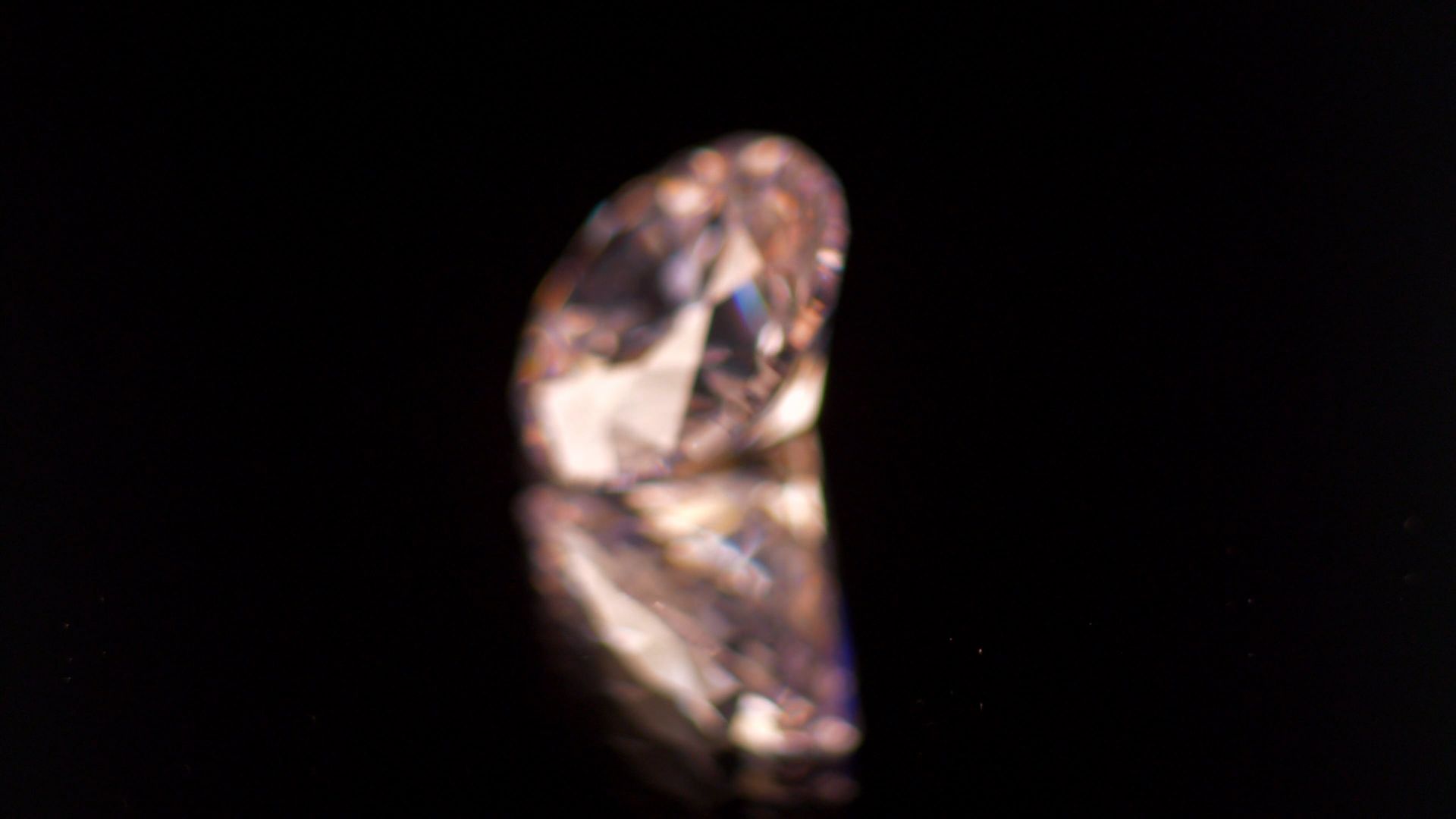
Moissanite and diamond are often compared because both are hard, brilliant and colourless. They are nonetheless different materials, and each has its own way of handling light.
The comparison
| Moissanite | Diamond | |
|---|---|---|
| Material | Silicon carbide | Carbon |
| Origin in jewelry | Created in laboratories | Natural or laboratory-grown |
| Hardness (Mohs) | About 9.25 | 10 |
| Refractive index | About 2.65–2.69 | About 2.42 |
| Dispersion (fire) | About 0.104 | About 0.044 |
| Optic character | Doubly refractive | Singly refractive |
| Specific gravity | About 3.2 | About 3.52 |
| Grading | Producer grades | 4Cs, independent laboratory reports |
| Price for the same size | Usually much lower | Higher |
How they look
Moissanite has more than twice the dispersion of diamond, so it shows stronger flashes of rainbow colour, especially in sunlight. Diamond shows a balance of white brilliance and fire that many people find calmer. Moissanite is also doubly refractive: seen through the stone at certain angles, facet edges can appear doubled. Neither look is better; they are different.
Weight and size
Moissanite is lighter than diamond. A moissanite of the same diameter as a one-carat round diamond weighs less than one carat, so compare stones by their dimensions in millimetres.
How to choose
- Choose diamond if the material itself, its hardness or independent grading matter most to you.
- Choose moissanite if you love its fire and prefer to put your budget into size or design.
- Whatever you choose, insist on an honest description. Moissanite must never be sold as diamond.
In different lights
Under direct sunlight or spotlights, moissanite's high dispersion produces vivid flashes of rainbow colour, sometimes called a disco-ball effect in larger stones. In softer indoor light, the difference is smaller. Diamond's light return is often described as crisper, with a balance of white flashes and colour. Seeing both in several kinds of light is the best way to know which you prefer.
Double refraction, explained
When light enters moissanite, it splits into two rays. Looking through the stone at an angle, the edges of the facets on the far side can appear doubled. Cutters usually orient moissanite so that this effect is minimised when the stone is viewed from above, but a trained eye with a loupe can often see it from the side. Diamond is singly refractive and never shows it.
Colour
Diamond colour is graded on the D-to-Z scale. Moissanite is sold in colourless and near-colourless qualities set by producers, and some stones can show a faint warm or grey tint in certain light. Ask to see the stone in daylight if you can.
Durability and care
Both suit everyday wear. Diamond is the hardest material known; moissanite is not far behind. Both attract oils and need regular cleaning to keep their brilliance. Read How to clean moissanite and How to clean a diamond ring.
A checklist before you decide
- Compare stones of the same size in millimetres.
- Look at them in sunlight and indoors.
- Decide whether independent grading matters to you.
- Consider how the price difference could be used: a larger stone, a better setting, or simply a lower cost.
Sources: Gemological Institute of America (gia.edu), gem encyclopedia and identification notes on synthetic moissanite; US Federal Trade Commission, Guides for the Jewelry, Precious Metals, and Pewter Industries, 16 CFR Part 23 (revised 2018).
Frequently asked questions
Can people tell moissanite from diamond?
Most people cannot at a glance. An expert may notice moissanite's stronger rainbow fire or doubled facet edges, and instruments distinguish them.
Which lasts longer?
Both are very durable. Diamond is harder (10 against about 9.25), but both suit daily wear with normal care.
Does moissanite look fake?
No. It is a brilliant gemstone. It looks different from diamond mainly in the amount of rainbow fire it shows, especially in sunlight.
Is moissanite heavier than diamond?
No, it is lighter. A moissanite of the same size weighs less than a diamond.


