


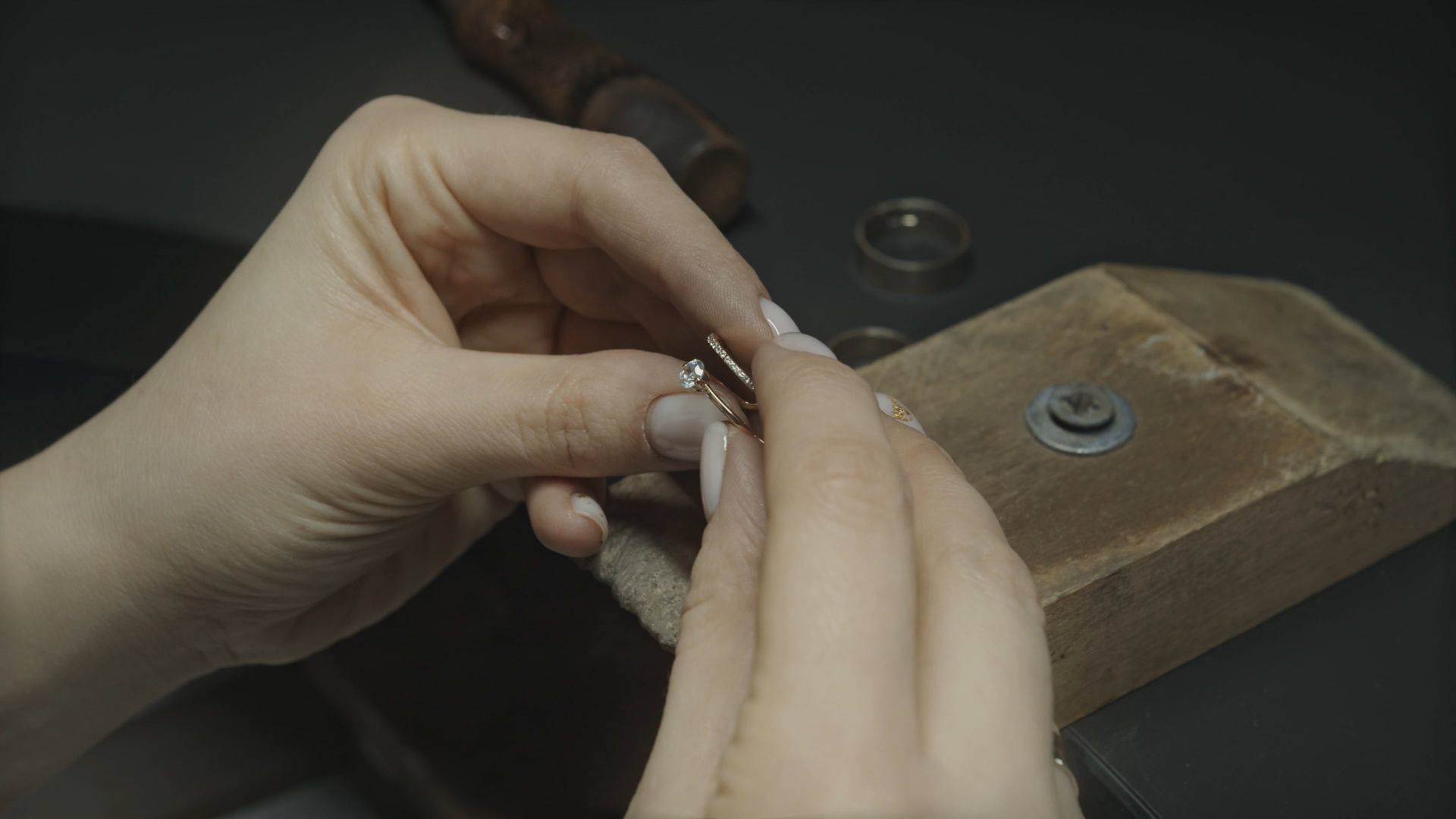
How ring sizes work
A ring size describes the inside of the ring. Different countries express it differently: the United States uses numbers, the United Kingdom uses letters, and much of Europe uses the international standard ISO 8653, in which the size is the inside circumference in millimetres.
Measuring at home
Method 1: a ring you already own
Choose a ring that fits the intended finger well. Measure its inside diameter in millimetres, edge to edge, across the widest point. Find the closest diameter in the chart below.
Method 2: string or paper strip
- Wrap a thin strip of paper or non-stretch string around the base of the finger.
- Mark where it overlaps, without pulling tight.
- Measure the length in millimetres. That is the circumference.
- Find the closest circumference in the chart. If it falls between two sizes, choose the larger one.
Measure at the end of the day, when fingers are at their largest, and avoid measuring when your hands are cold.
International ring size chart
Diameter is calculated from the US size (diameter in mm = 11.63 + 0.8128 × US size) and circumference as π × diameter. UK letter sizes vary slightly between charts and are given as a guide.
| US | UK (approx.) | Diameter (mm) | Circumference (mm) | EU / ISO |
|---|---|---|---|---|
| 4 | H | 14.9 | 46.8 | 47 |
| 4.5 | I | 15.3 | 48.0 | 48 |
| 5 | J½ | 15.7 | 49.3 | 49 |
| 5.5 | K½ | 16.1 | 50.6 | 51 |
| 6 | L½ | 16.5 | 51.9 | 52 |
| 6.5 | M½ | 16.9 | 53.1 | 53 |
| 7 | N½ | 17.3 | 54.4 | 54 |
| 7.5 | O½ | 17.7 | 55.7 | 56 |
| 8 | P½ | 18.1 | 57.0 | 57 |
| 8.5 | Q½ | 18.5 | 58.2 | 58 |
| 9 | R½ | 18.9 | 59.5 | 60 |
| 9.5 | S½ | 19.4 | 60.8 | 61 |
| 10 | T½ | 19.8 | 62.1 | 62 |
| 10.5 | U½ | 20.2 | 63.3 | 63 |
| 11 | V½ | 20.6 | 64.6 | 65 |
| 11.5 | W½ | 21.0 | 65.9 | 66 |
| 12 | Y | 21.4 | 67.2 | 67 |
| 12.5 | Z | 21.8 | 68.5 | 68 |
| 13 | Z+1 | 22.2 | 69.7 | 70 |
Fit considerations
- Wide bands feel tighter than narrow ones. For bands wider than about 6 mm, consider a quarter or half size larger.
- Knuckles: if your knuckle is larger than the base of your finger, the ring must pass over the knuckle and still sit securely.
- Between sizes: choose the larger size.
- Stacking: several rings worn together can feel tighter than one.
Need help?
If you are sizing a ring as a surprise, or you are unsure, request a consultation. We will help you estimate discreetly.
Standard referenced: ISO 8653 (ring size designation by inside circumference). Conversions calculated by DORVETTI; small differences exist between published charts.
Frequently asked questions
What if I am between two sizes?
Choose the larger size, especially for wider bands. Fingers change size with temperature and time of day.
Does a wide band need a bigger size?
Often, yes. Bands wider than about 6 mm usually feel tighter; many people go up by a quarter or half size.
What is an EU or ISO ring size?
It is the inside circumference of the ring in millimetres. A ring with an inside circumference of 54 mm is size 54.


