


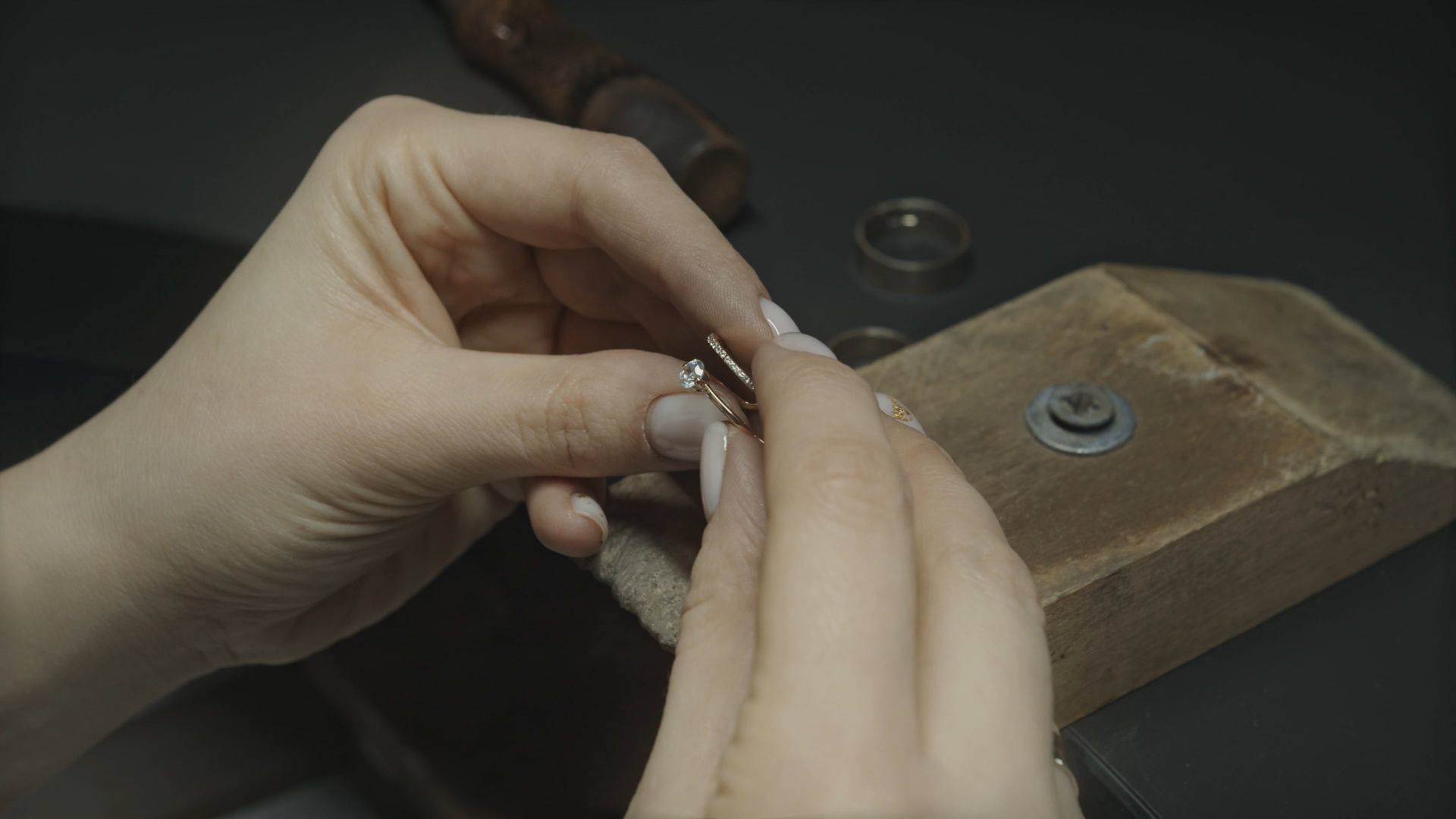
The most reliable way to know a ring size is to be sized by a jeweller. When that is not possible, these methods, done carefully, give a good estimate. Convert your measurement with our Ring Size Guide.
Method 1: measure a ring that fits
This is the most reliable method at home.
- Choose a ring that fits the intended finger well.
- Place it on a ruler and measure the inside diameter, from inner edge to inner edge, in millimetres.
- Find that diameter in the Ring Size Guide.
Method 2: a ring sizer
A reusable plastic or metal ring sizer, slipped on like a ring, measures the finger directly. Follow its instructions and check the result on two different days.
Method 3: string or paper
The least reliable method, but useful as a check.
- Wrap a thin strip of paper or non-stretch string around the base of the finger.
- Mark where it overlaps, without pulling it tight.
- Measure the length in millimetres: that is the circumference, which is also the EU size.
Make sure the strip can pass over the knuckle; measure three times and use the average.
Details that matter
- Temperature: fingers are smaller in the cold and larger in the heat. Measure at room temperature.
- Time of day: fingers can swell during the day; the end of the day is a good moment to measure.
- Knuckles: if the knuckle is larger than the base of the finger, the ring must pass over it.
- Band width: wide bands fit more tightly than narrow ones; for bands of about 6 mm or more, consider going up half a size.
Common mistakes
- Measuring when your hands are cold, which makes fingers smaller.
- Pulling a string or paper strip too tight, or using a material that stretches.
- Measuring the outside diameter of a ring instead of the inside.
- Measuring a ring worn on a different finger or hand.
- Forgetting that wide bands fit more tightly than narrow ones.
Measuring for a surprise
If the ring is a surprise, borrow a ring that is worn on the right finger, trace its inside edge on paper or press it into soft soap, and measure the inside diameter. If that is impossible, ask a close friend or relative who may know the size. When in doubt, choose slightly larger: making a ring smaller is often simpler than making it larger.
Half and quarter sizes
Many ring-size systems include half sizes, and some rings are made in quarter sizes. If you are between two sizes, the width of the band, the shape of your knuckle and the season all help decide which way to go.
Different systems
Ring sizes are expressed differently from country to country: EU sizes follow the inside circumference in millimetres, UK sizes use letters and US sizes use numbers. The Ring Size Guide converts between them.
Sources: ISO 8653 ring-size convention (inside circumference in millimetres).
Frequently asked questions
What if I am between two sizes?
Choose the larger size, especially for wide bands, or ask for guidance before ordering.
Can I measure someone's size secretly?
Borrow a ring they wear on the right finger and measure its inside diameter, or ask a friend or relative who knows.
Is it easier to make a ring smaller or larger?
Often smaller, but it depends on the design and metal. Some rings, such as full-eternity bands, cannot be resized.
Do ring sizes differ between brands?
The systems are standard, but the feel of a ring can differ with its width and inner profile.


