


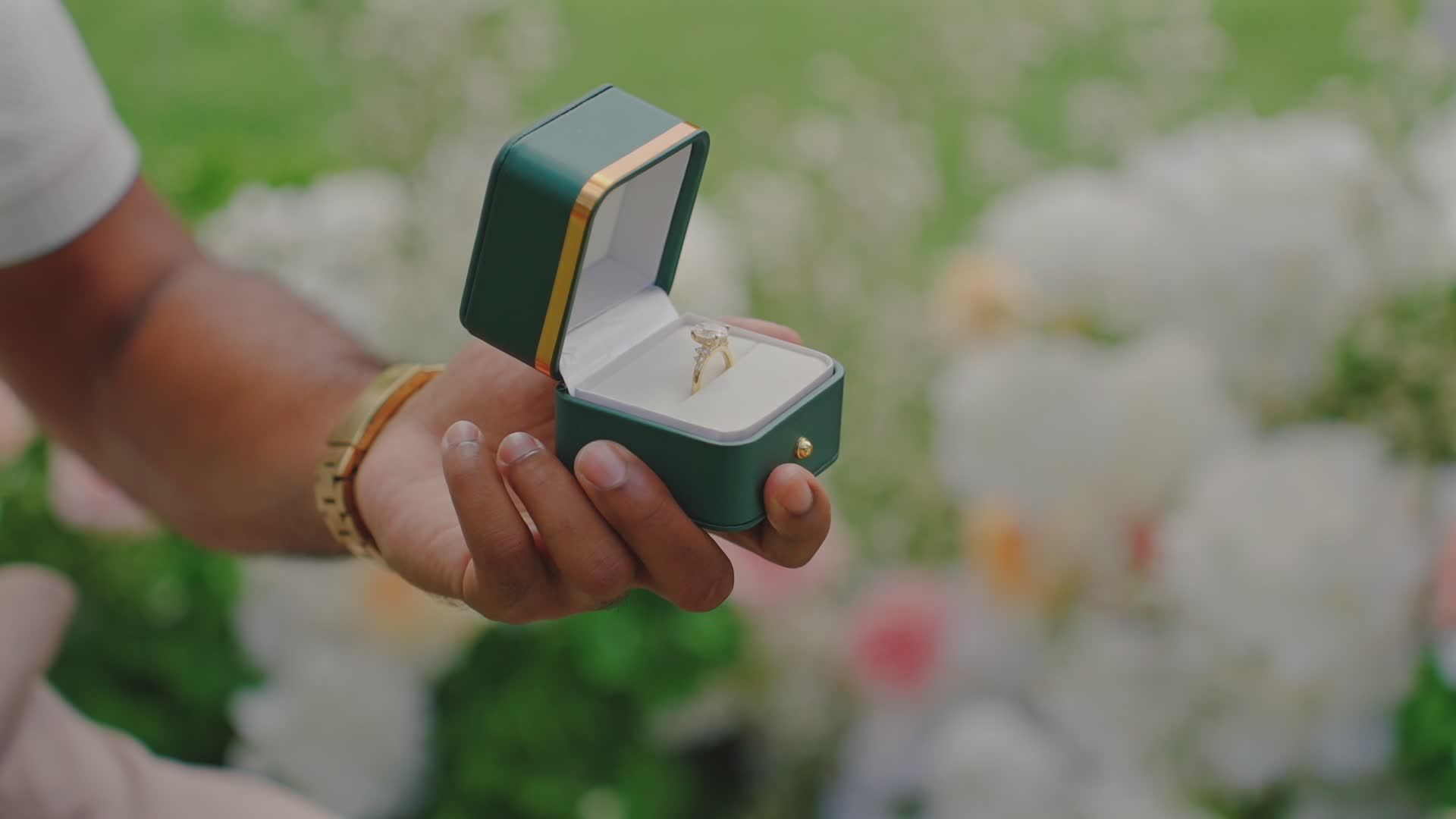
A well-fitted ring slides over the knuckle with slight resistance, sits comfortably at the base of the finger and does not slip off when you shake your hand. It should be noticeable, not uncomfortable.
Signs of the right fit
- It needs a gentle push to pass the knuckle, and a gentle twist to come off.
- It stays in place when your hand hangs down or you shake it lightly.
- It leaves no deep mark and does not cause swelling.
Too tight or too loose
| Too tight | Too loose |
|---|---|
| Hard to remove, even at room temperature | Slides off easily, especially in the cold |
| Leaves a deep indentation or red mark | Spins constantly so the stone faces the palm |
| Fingers feel swollen around it | Slips to the knuckle when your hand hangs down |
Top-heavy rings
Rings with a larger centre stone tend to rotate. A slightly snugger fit, a flattened inner profile or a squared band can help it stay upright.
Comfort fit
A comfort-fit band has a rounded inner surface. It slides more easily over the knuckle and can feel looser than a flat inner band of the same size.
When the fit is wrong
Many rings can be resized by a jeweller. Pavé bands, eternity rings and some metals are more complex or impossible to resize, so ask before you buy. Use our Ring Size Guide to get as close as possible from the start.
When fingers change
Finger size changes with temperature, time of day, pregnancy, weight changes and age. A ring that fits perfectly in winter may feel tight in summer. Size the ring for the conditions in which it will be worn most, and remember that small daily variations are normal.
Large knuckles
If the knuckle is much larger than the base of the finger, a ring big enough to pass the knuckle will be loose once on. Solutions include small sizing beads inside the band, a slightly squared inner profile, or, for more significant differences, specialised hinged shanks. A jeweller can advise on what suits the design.
Resizing limits
| Design | Resizing |
|---|---|
| Plain gold or platinum band | Usually straightforward, within a range |
| Solitaire | Usually possible; the setting may need checking afterwards |
| Pavé or channel-set band | More complex; stones may need resetting |
| Full-eternity band | Usually not possible |
| Engraved band | Possible, but engraving may be affected |
A quick test at home
With the ring on, make a fist and open your hand, then let your arm hang and shake your hand gently. A good fit stays in place and does not feel tight in either position.
Sources: General jewellers' fitting guidance.
Frequently asked questions
Is it normal for a ring to turn slightly?
A little movement is normal, especially with a heavier centre stone. Constant spinning suggests the ring is too large or top-heavy.
Can a ring that is too big be fixed without resizing?
Sizing beads or an insert can help, but resizing is the proper solution when possible.
Should an engagement ring be tight?
Snug, not tight. It should need a gentle push over the knuckle and sit comfortably without leaving a deep mark.
What if my fingers swell in summer?
Size for your typical conditions and accept small seasonal changes. If swelling is significant, a comfort-fit profile can help.


