


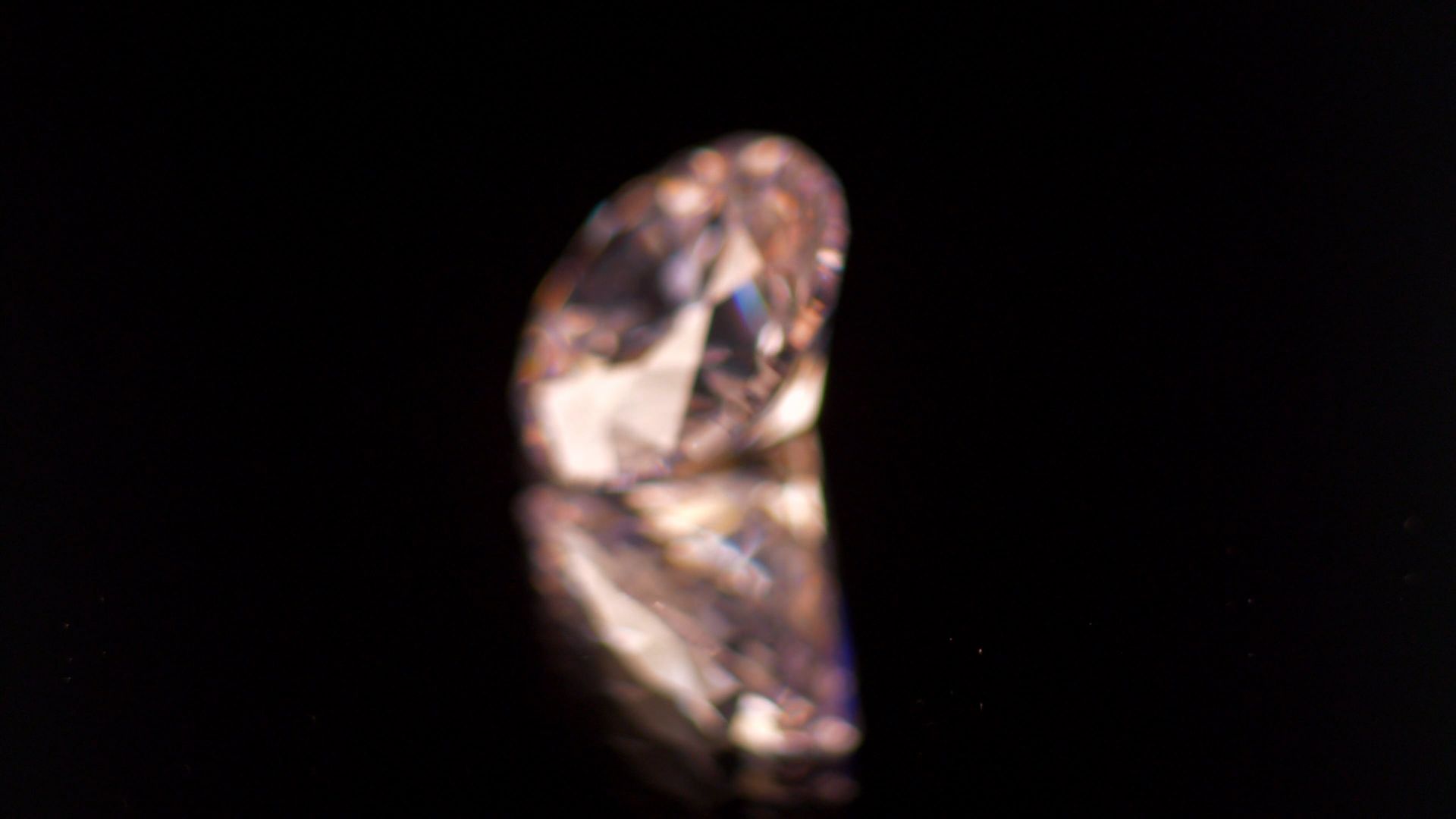
Of the 4Cs, cut is the only one shaped entirely by human skill. It describes how well a diamond's facets interact with light, and it has the greatest influence on how much a diamond sparkles.
What a good cut achieves
- Brightness: the white light reflected from the diamond.
- Fire: flashes of spectral colour as light is dispersed.
- Scintillation: the pattern of sparkle and contrast as the diamond, the light or the viewer moves.
Proportions
A diamond's appearance depends on how its parts relate to one another: the table (the large top facet), the crown and pavilion angles, the depth, the girdle and the culet. If a diamond is cut too deep or too shallow, light escapes through the sides or the bottom instead of returning to the eye, and the stone can look dark or glassy.
How cut is graded
For standard round brilliant diamonds, laboratories such as GIA assign an overall cut grade from Excellent to Poor, based on proportions, polish and symmetry. Some laboratories use the term Ideal as a grade; terms such as "triple excellent" are trade shorthand for Excellent cut, polish and symmetry.
| Grade | What to expect |
|---|---|
| Excellent | High brightness, fire and scintillation |
| Very Good | Strong performance, slightly below the top grade |
| Good | Pleasing, with some compromise in light return |
| Fair, Poor | Noticeably less sparkle |
Fancy shapes
Ovals, cushions, pears and other fancy shapes do not receive an overall cut grade from GIA. Their reports grade polish and symmetry, and the best judge is your eye: look for even sparkle, a pleasing outline and, in elongated shapes, a minimal bow-tie.
Cut and size
A well-cut diamond can look larger than a heavier stone cut too deep, because more of its weight is visible from above. Read What is carat weight?.
Reading proportions on a report
| Measure | What it describes |
|---|---|
| Table % | The width of the top facet as a percentage of the diameter |
| Depth % | Total height as a percentage of the diameter |
| Crown angle | The slope of the upper part, which influences fire |
| Pavilion angle | The slope of the lower part, which influences brightness |
| Girdle | The thickness of the edge; very thin girdles are more prone to chipping |
| Culet | The point at the bottom; ideally small or absent |
No single number makes a good cut. The relationship between the measurements matters, which is why an overall cut grade is so useful for round brilliants.
Polish and symmetry
Polish describes the smoothness of the facet surfaces; symmetry describes the precision of their shape and alignment. Both are graded from Excellent to Poor and both contribute to how cleanly a diamond returns light.
Cut and laboratory-grown diamonds
Laboratory-grown diamonds are cut by the same methods and graded on the same scales. Their cut quality varies just as it does for natural stones, so the cut grade remains the first thing to check.
Sources: Gemological Institute of America (gia.edu), the 4Cs of diamond quality and GIA grading scales.
Frequently asked questions
Is cut the same as shape?
No. Shape is the outline, such as round or oval. Cut describes how well the facets are proportioned and finished.
Do fancy shapes have a cut grade?
Laboratories such as GIA give an overall cut grade only to standard round brilliants; for other shapes, reports grade polish and symmetry, and the stone should be judged by eye.
What is a good table percentage?
There is no single best value; it works together with the other proportions. For round brilliants, the overall cut grade is a more reliable guide than any one measurement.
Does a thin girdle matter?
A very thin girdle is more vulnerable to chipping. Protective settings help.


