


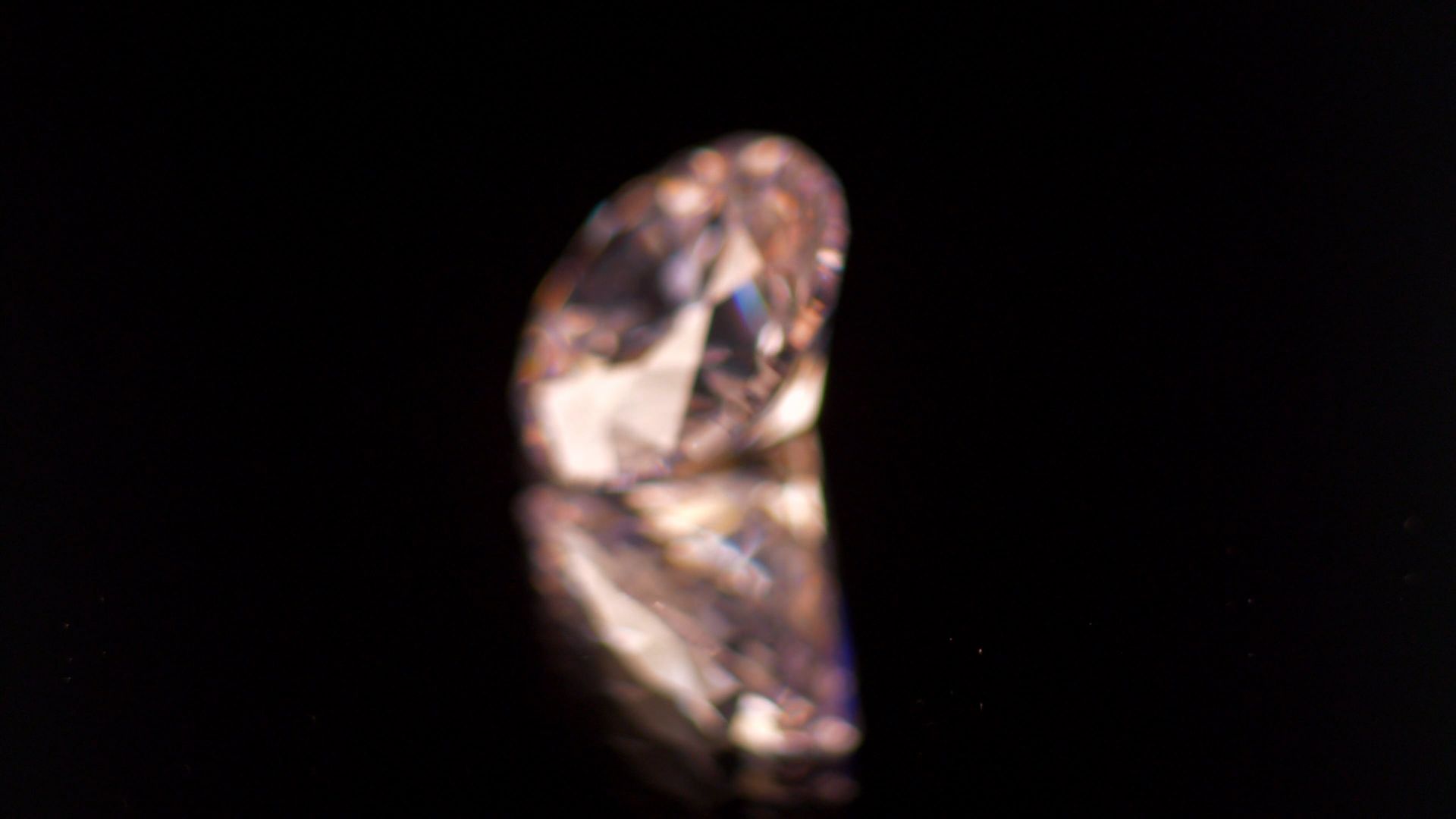
A laboratory-grown diamond is diamond that has been grown by people under controlled conditions instead of forming deep in the earth. It is not an imitation: it is made of carbon arranged in the same cubic crystal structure as a natural diamond, so it has the same hardness, the same way of handling light and the same chemistry.
Diamond, not a look-alike
The distinction that matters most is between a laboratory-grown diamond and a diamond simulant. A simulant only resembles diamond. Cubic zirconia, glass and moissanite are all different materials with their own properties. A laboratory-grown diamond is the real material, created by a different route.
| Laboratory-grown diamond | Natural diamond | Simulant (e.g. cubic zirconia) | |
|---|---|---|---|
| Material | Diamond (carbon) | Diamond (carbon) | A different material |
| Origin | Grown under controlled conditions | Formed in the earth | Manufactured |
| Hardness (Mohs) | 10 | 10 | Lower (cubic zirconia about 8–8.5) |
| Graded with the 4Cs | Yes | Yes | No |
How they are named
Because a laboratory-grown diamond looks and behaves like a natural one, honest naming is essential. In the United States, the Federal Trade Commission's Jewelry Guides define a diamond by what it is, not where it comes from, and require a diamond created in a laboratory to be clearly qualified, with words such as "laboratory-grown", "laboratory-created" or "[manufacturer]-created". DORVETTI applies the same principle in every market: a laboratory-grown diamond is always described as laboratory-grown.
How they are made
There are two main methods. HPHT (high pressure, high temperature) recreates the pressure and heat found deep in the earth. CVD (chemical vapour deposition) builds diamond layer by layer from a carbon-rich gas. Both start from a small diamond seed. Read How are lab-grown diamonds made? and CVD vs HPHT.
How they are identified and graded
A laboratory-grown diamond cannot be told apart from a natural one by eye or with a jeweller's loupe. Gemmological laboratories use specialised instruments that reveal growth patterns and trace elements. Independent laboratories grade laboratory-grown diamonds with the same 4Cs used for natural stones, state their origin on the report, and often laser-inscribe the girdle. See Certificates & Authenticity.
What to check before you buy
- Disclosure: the description and the invoice should say "laboratory-grown" clearly.
- A report: for a significant stone, an independent grading report is a useful description of the diamond.
- The 4Cs: cut, colour, clarity and carat weight matter exactly as they do for a natural diamond. Read What are the 4Cs?.
- Claims: statements about sustainability or ethics should be supported by evidence. DORVETTI does not make such claims unless they have been verified.
A short history
Scientists tried to make diamond for more than a century before succeeding. The first reproducible synthesis was achieved in 1954 by researchers at General Electric, using high pressure and high temperature. The earliest crystals were small and suited only to industry, where diamond's hardness is used in cutting and drilling tools. Crystals of gem quality followed in the early 1970s, but for decades they remained costly and rare. Improvements in both HPHT and CVD growth have since made laboratory-grown diamonds of gem quality widely available.
Colour and clarity
Laboratory-grown diamonds are graded on the same colour and clarity scales as natural diamonds, and they span a similar range. Colourless and near-colourless stones are common, and fancy colours such as blue, pink or yellow can also be produced, sometimes through treatment after growth. Their inclusions tend to differ from those of natural diamonds: small metallic particles in some HPHT stones, dark pinpoints of non-diamond carbon in some CVD stones. Those differences help laboratories identify origin; to the unaided eye, a well-graded laboratory-grown diamond looks like any fine diamond.
Price and value
Because laboratory-grown diamonds can be produced to order, their prices have fallen considerably in recent years and are generally well below those of natural diamonds of similar size and quality. This is an advantage when choosing, but it also means they should be bought to be worn and enjoyed rather than as a store of value. The same applies, in practice, to most jewelry.
Lab-grown diamonds in everyday jewelry
Laboratory-grown diamonds are used in every kind of piece: solitaire and three-stone engagement rings, stud earrings, tennis bracelets and eternity bands. For pieces with many small stones, ask whether all of them are laboratory-grown, natural or a mixture, since the description should cover every stone, not only the largest one.
Sources: US Federal Trade Commission, Guides for the Jewelry, Precious Metals, and Pewter Industries, 16 CFR Part 23 (revised 2018); Gemological Institute of America (gia.edu), resources on laboratory-grown diamonds.
Frequently asked questions
Is a lab-grown diamond the same as cubic zirconia?
No. Cubic zirconia is a different material that imitates diamond. A laboratory-grown diamond is diamond.
Will a diamond tester recognise a lab-grown diamond as diamond?
Yes. Because it is diamond, standard testers identify it as such. Distinguishing laboratory-grown from natural requires laboratory instruments.
Are lab-grown diamonds graded?
Yes. Independent laboratories grade them and their reports state that the stone is laboratory-grown.
Can lab-grown diamonds be coloured?
Yes. Colourless and near-colourless stones are most common, but fancy colours such as blue and pink are also produced, sometimes by treatment after growth, which should be disclosed.
Do lab-grown diamonds last as long as natural ones?
Yes. They are the same material, with the same hardness and stability.


